Introduction
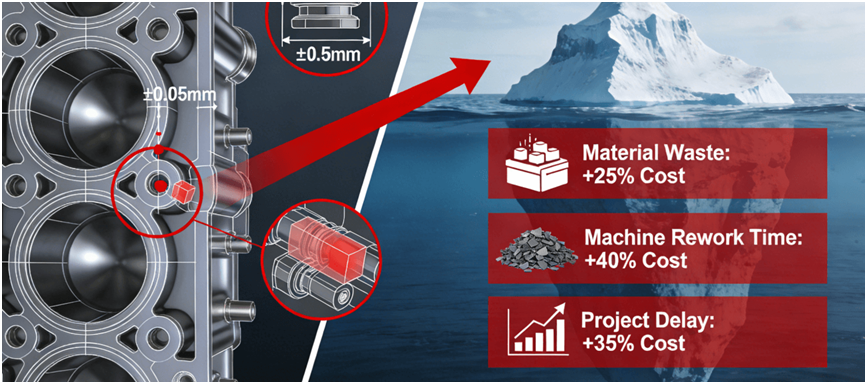
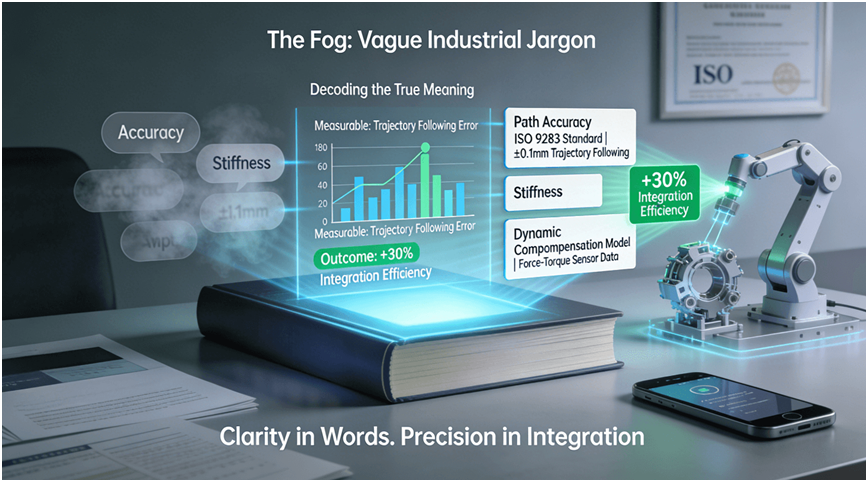
When evaluating 5-axis robotic machining solutions, cross-functional teams (design, process, procurement) often reach an impasse due to differing interpretations of key terms like “accuracy,” “stiffness,” and “offline programming.” The “path accuracy” sought by engineers may be entirely different from a supplier’s advertised “repeatability.” This terminology misalignment leads directly to selection errors, integration delays, and an average loss of 30% in expected efficiency. The root cause is the inherent ambiguity and context-specific nature of industrial jargon. Without a shared, authoritative framework for defining terms, communication remains superficial, unable to penetrate marketing language and reach the technical truth, resulting in procurement decisions based on incomplete or misunderstood information.
This article provides an “Operational Glossary of Key Terms” for 5-axis robotic machining integration. We will move beyond dictionary definitions to provide “measurable, verifiable” clarifications of core terminology, anchored in the goals of an integration project (e.g., machining consistency, long-term stability). It also supplies a supplier capability “decoding” checklist based on this framework, transforming vague claims into auditable technical dialogue. Let’s start by clarifying the most critical and often confused set of terms that differentiate “robotic machining” from “traditional CNC machining” in both language and essence.
Why Does “5-Axis Capability” Mean Wildly Different Things on a Robot vs. a CNC Mill?
This section deconstructs the core terminology of “5-axis,” arguing that it represents fundamentally different engineering challenges and capabilities in the contexts of rigid CNC machines and flexible robotic arms.
1. The Kinematic Divide: Degrees of Freedom vs. Precision Architecture
In the CNC world, “5-axis simultaneous machining” refers to a tightly integrated motion system built upon a rigid machine tool structure, where all five axes work in concert to maintain optimal tool orientation for precision. In robotics, “5-axis” or “6-axis” primarily describes the number of kinematic joints (degrees of freedom) in the arm, granting it a vast, dexterous workspace. The core challenge shifts from maintaining absolute rigidity to managing and compensating for inherent structural compliance. Understanding this divide is the first step to setting realistic expectations. The “5-axis capability” label on a robot brochure does not automatically equate to the precision architecture of a dedicated 5-axis machining center.
2. The “Usable Precision Envelope”
A robot’s entire workspace is not automatically a “machining volume.” Due to compliance and other factors, the region where it can achieve the necessary stiffness and accuracy for cutting is often a smaller, well-defined subset. A critical term to clarify with any supplier is the size and location of this “usable precision envelope” for your specific part size and required tolerances, which is far more meaningful than the total reach of the arm. For example, a robot might have a 2-meter reach, but its usable machining volume for ±0.1mm path accuracy might be only a 0.5-meter cube near the base.
3. Establishing a Common Language Framework
To ground this discussion, the industry looks to standards bodies. The Robotics Industries Association (RIA), for instance, provides guidelines for performance testing and terminology, offering a baseline for comparing capabilities. Framing questions within such standardized contexts helps move past vague claims. To deeply explore how to apply this terminology in practice for partner selection, this comprehensive guide on 5-Axis robotic machining services provides a complete path from theory to evaluation.
“Accuracy” vs. “Repeatability” vs. “Path Accuracy”: Which One Actually Determines Your Part Quality?
This section provides operational, measurable definitions for the most critical — and most conflated — set of precision terms, guiding readers on which metric matters most for their specific application.
1. Repeatability: The Benchmark for Batch Consistency
Repeatability (or Repeat Positioning Accuracy) answers: “Can the robot return to the same taught point over and over?” It’s measured statistically (e.g., ±0.02mm). This is crucial for high-volume production where the same path is run thousands of times. However, a robot with high repeatability can still be consistently wrong if its initial position is off — which is an accuracy problem. Suppliers often highlight repeatability because it’s easier to measure and sounds impressive, but it doesn’t guarantee the part will be dimensionally correct.
2. Absolute Accuracy: The Foundation for “First-Part Correct”
Absolute Accuracy answers: “Does the robot’s end-effector go exactly where the global coordinate system says it should?” It’s affected by kinematic model errors, gear backlash, and link deflection. Poor absolute accuracy means a perfectly programmed path for a perfect CAD model will still produce a flawed part. This is often the most challenging spec for robots and requires sophisticated kinematic calibration. For a 5-axis machining cell, absolute accuracy is the foundation upon which all other precision is built, especially for complex, one-off components.
3. Path Accuracy / Trajectory Following: The Key for Contour Quality
Path Accuracy is the most critical term for machining. It measures how closely the robot follows a continuous, pre-programmed trajectory. This is especially vital for complex freeform surfaces like turbine blades or automotive panels. A robot might have perfect repeatability and acceptable absolute accuracy, but if its path accuracy degrades under load or at high speed, the surface finish will suffer. This metric is directly tied to the part’s functional quality, not just its positional correctness.
What Does “Stiffness” or “Compliance” Really Imply for Machining Forces?
This section decodes the physical meaning of stiffness and compliance, explaining why robotic machining requires a different approach to force management compared to traditional CNC.
l Compliance vs. CNC Rigidity: Traditional CNC machines are designed for high static and dynamic stiffness to resist deflection under heavy cutting forces. Robots, by contrast, are inherently compliant structures. When a cutting force is applied, the robot arm will deflect slightly — a phenomenon known as “tool deflection” or “chatter.” This is not a flaw; it’s a fundamental characteristic of articulated arms. The real question is not “Is it stiff?” but “How is this compliance managed to ensure part quality?”
l Force Control and Real-Time Compensation: The Technical Differentiator: The key to successful robotic machining is not hiding compliance but actively managing it through force control and real-time compensation. This involves integrating force-torque sensors and advanced control algorithms that continuously monitor the cutting process and adjust the tool path or feed rate to maintain a constant contact force. A supplier that merely claims “high rigidity” without detailing their force control strategy is likely underestimating the complexity of the task.
l Evaluating the Supplier’s Depth of Solution: When evaluating a supplier, ask: “How do you compensate for the robot’s compliance during machining?” If their answer involves sophisticated modeling, real-time feedback loops, and validated case studies, they are likely a true partner. If they dismiss the issue or suggest it’s negligible, they may lack the technical depth for demanding applications. To transform these advanced compensation concepts into stable productivity, it ultimately depends on a 5 axis CNC machining services factory with full-stack expertise from process to control.
“Offline Programming” vs. “Simulation”: A Glossary for De-risking Deployment.
This section clarifies the terminology around software and deployment, distinguishing between basic programming, simulation, and true digital twin technology.
1. Offline Programming (OLP): Creating Programs Away from the Machine
Offline Programming is the process of creating robot programs on a computer, away from the physical robot, using CAD models and toolpaths. This is essential for 5-axis machining, as manually teaching complex paths is impractical. However, OLP alone does not guarantee success. The program must be validated before execution.
2. Simulation: Validating Reach, Collisions, and Kinematics
Simulation involves running the OLP-generated program in a virtual environment to check for reachability, collisions, and kinematic feasibility. While useful, basic simulation may not account for the robot’s dynamic behavior under load or its compliance characteristics. It’s a necessary step but not sufficient for high-precision machining.
3. Digital Twin: Predictive Validation for Machining Performance
The true value lies in Digital Twin technology, which creates a high-fidelity virtual replica of the entire machining cell, including robot dynamics, controller characteristics, and process parameters. This allows for predictive validation of the machining process, identifying issues like vibration, thermal drift, or path deviation before the first cut. This level of simulation can reduce on-site commissioning time by 70% or more. Suppliers should be asked: “Do you provide digital twin validation for your machining processes, and what level of fidelity does it include?”
Translating Your RFQ: A Terminology Checklist for Supplier Evaluation
This section provides a practical, actionable checklist to translate terminology knowledge into concrete evaluation criteria for your Request for Quotation (RFQ).
- Asking the Right Questions About Force and Path: In your RFQ or during supplier evaluation, ask: “For our [specific material] machining, what force control strategy will you use to ensure corner accuracy?” and “Please show us a case study where digital twin/simulation identified a typical interference issue and the solution implemented.” Also, inquire: “Is the ‘accuracy data’ you provide based on ISO 9283 path accuracy testing, or is it static repeatability?” These questions immediately distinguish between suppliers who use terminology correctly and those who merely parrot marketing buzzwords.
- Requiring Standardized Validation Protocols: Demand that the supplier provide validation protocols aligned with industry standards. For example, ask for a Runoff or Acceptance Test using a representative part (or a qualified test piece like NAS 979) under production-simulated conditions (e.g., after warm-up). The test should include CMM data or laser tracker measurements comparing actual vs. commanded positions to prove the claimed path accuracy. This rigorous validation is a non-negotiable step for ensuring the investment delivers the promised performance
- Assessing Long-Term Stability and Thermal Management: Finally, inquire about thermal management: “What strategy do you use to manage thermal drift over an 8-hour shift?” High-end systems incorporate thermal compensation models using temperature sensors to adjust commands in real-time. A supplier that cannot address this is likely not equipped for sustained, high-precision production. The ability to articulate a robust strategy for long-term stability, including preventative maintenance and recalibration protocols, is a key indicator of a mature and reliable integration partner.
Conclusion
In the complex domain of 5-axis robotic machining integration, clear, consistent, and operational terminology is not just a communication tool — it is a risk management instrument and a mirror of technical capability. By adopting the operational glossary provided in this guide, teams can elevate their conversations with suppliers from subjective “capability claims” to objective “performance verification” and “methodology substantiation.” This not only prevents costly misalignment but also identifies true engineering partners capable of translating advanced terminology into reliable, high-quality production.
FAQs
Q: What’s the typical accuracy range we can realistically expect from a well-integrated 5-axis robotic machining cell?
A: For operations like trimming or milling on aluminum or composites, a well-integrated cell with calibration and compensation can achieve a dynamic path accuracy in the range of ±0.05mm to ±0.1mm. This suits large-part applications (molds, composite tools) but is not a substitute for a 5-axis CNC mill where micron-level precision on small, dense metals is required.
Q: How critical is “force control” for robotic machining, and is it a standard feature?
A: Force control is critical for consistent results on variable surfaces or compliant materials. It is not a standard feature on all robots; it is an advanced add-on requiring specific hardware (a force-torque sensor) and software. Always ask if it’s included and request demonstration data for a similar application.
Q: We have existing CNC programs (G-code). Can they be used directly on a robot?
A: Not directly. G-code is for rigid CNC kinematics. However, advanced Offline Programming (OLP) software can import CAD models and toolpaths, then generate optimized, collision-free robot programs, leveraging your existing machining strategy knowledge without direct G-code translation.
Q: What is the single biggest factor affecting the long-term accuracy stability of a robotic cell?
A: Thermal drift is a major factor. High-end systems use thermal compensation models with temperature sensors to adjust commands in real-time. Always ask integrators about their strategy for managing thermal effects over a full production shift.
Q: How do we validate the accuracy claims of an integrator before purchasing?
A: Insist on a Runoff or Acceptance Test using a qualified test piece (like a NAS 979 standard) or a representative part of yours. The test must simulate production conditions and be followed by a full report with CMM or laser tracker data comparing actual vs. commanded positions, proving the claimed path accuracy.
Author Bio
This article is based on deep, practical experience at the intersection of advanced manufacturing systems integration and precision machining. As a certified manufacturing and automation solutions partner (ISO 9001, IATF 16949, AS9100D), LS Manufacturing is dedicated to transforming complex technical concepts into predictable, high-quality production outcomes.