
The National Health Service (NHS) stands at a critical crossroads where the demand for high-quality care must be balanced with fiscal responsibility and evolving patient complexities. As we look toward the future of healthcare in the United Kingdom, one methodology stands out as the gold standard for achieving clinical excellence: Evidence-Based Practice (EBP).
EBP is not merely a buzzword; it is a systematic approach to decision-making that integrates the best available research evidence with clinical expertise and patient values. By transitioning from traditional, intuition-based care to data-driven protocols, the NHS can ensure that every intervention is both safe and effective.
The Three Pillars of Evidence-Based Practice
To understand why EBP is the future, we must look at its foundational components. Clinical excellence occurs at the intersection of three distinct pillars:
- Best Research Evidence: Utilizing clinically relevant research, often from the basic sciences of medicine, but especially from patient-centered clinical research.
- Clinical Expertise: The ability to use clinical skills and past experience to rapidly identify each patient’s unique health state and diagnosis.
- Patient Values and Preferences: The unique preferences, concerns, and expectations each patient brings to a clinical encounter.
In the modern clinical landscape, students and practitioners often seek specialized nursing assignment help to master the complexities of these pillars, ensuring that their academic foundation aligns with the rigorous standards required by the Nursing and Midwifery Council (NMC).
Driving Clinical Excellence in the NHS
The NHS Long Term Plan emphasizes the need for digitally-enabled care and a workforce that is capable of implementing the latest medical breakthroughs. EBP provides the framework for this evolution in several ways:
1. Standardisation of Care
EBP facilitates the creation of Clinical Practice Guidelines (CPGs). When NHS trusts follow standardized, evidence-based protocols, it reduces the “postcode lottery” effect, where the quality of care varies significantly depending on geographical location. This consistency is vital for maintaining public trust and ensuring equitable health outcomes.
2. Cost-Effectiveness and Resource Allocation
With the NHS facing unprecedented budget constraints, EBP serves as a tool for economic efficiency. By identifying treatments that are ineffective or redundant, clinicians can reallocate resources toward interventions that have a proven track record of success. For example, the implementation of the Getting It Right First Time (GIRFT) programme is a direct application of EBP aimed at reducing unwarranted variations in clinical practice.
3. Improved Patient Safety
According to data from NHS Resolution, clinical negligence claims cost the system billions annually. EBP minimizes the risk of medical errors by ensuring that practitioners are not relying on outdated habits but are instead using the most current, peer-reviewed methods for wound care, medication administration, and surgical procedures.
The Role of Academic Rigor in Professional Development
The shift toward an EBP-centric NHS begins in the classroom. Future healthcare professionals must be adept at searching databases like CINAHL and PubMed, critically appraising literature, and synthesizing findings into clinical reports. Because these tasks are increasingly complex, many professionals find that professional assignment help is a valuable resource for refining their technical writing and ensuring their work meets the E-E-A-T (Experience, Expertise, Authoritativeness, and Trustworthiness) standards demanded by modern academia.
Barriers to EBP Implementation
Despite its benefits, the transition to a fully evidence-based NHS is not without challenges.
- Time Constraints: Nurses and doctors often lack the protected time required to stay updated with the thousands of studies published monthly.
- Access to Resources: Not all clinicians have immediate access to high-paywall journals or the statistical training required to interpret complex data.
- Resistance to Change: Cultural “inertia” within certain clinical settings can prevent the adoption of new, evidence-backed techniques in favor of “the way we’ve always done it.”
Key Takeaways
- Holistic Decision-Making: EBP combines the latest research with practitioner experience and patient choice.
- Consistency: It reduces regional variations in care quality across the UK.
- Efficiency: EBP helps the NHS cut costs by eliminating ineffective treatments.
- Continuous Improvement: The “Assess” phase of EBP ensures that clinical outcomes are constantly monitored and protocols updated.
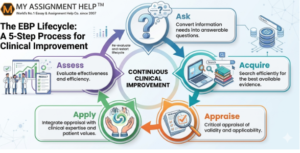
Conclusion: A Culture of Inquiry
The future of NHS clinical excellence depends on fostering a “culture of inquiry” where staff are encouraged to question existing practices and seek better alternatives. By embedding Evidence-Based Practice into the very fabric of clinical training and daily operations, the NHS can continue to lead the world in providing universal, high-quality, and scientifically sound healthcare.
FAQ: Understanding EBP in the UK
Q: What is the most common level of evidence used in EBP?
A: Systematic reviews and Meta-analyses of Randomized Controlled Trials (RCTs) are considered the “Gold Standard” or Level 1 evidence in the hierarchy of research.
Q: How does NICE support Evidence-Based Practice?
A: The National Institute for Health and Care Excellence (NICE) provides evidence-based guidance, advice, and information services for health, public health, and social care professionals in the UK.
Q: Why is EBP important for nursing students?
A: It is a core requirement of the NMC Future Nurse standards, ensuring that all registered nurses can provide safe, evidence-based care throughout their careers.
References
- NICE (2023). About NICE: Our Role in the NHS. London: National Institute for Health and Care Excellence.
- NHS England (2019). The NHS Long Term Plan.
- Sackett, D. L., et al. (1996). Evidence-based medicine: what it is and what it isn’t. BMJ, 312(7023).
- GIRFT (2022). Getting It Right First Time: National Reports.
About the Author
Dr. Sarah Bennett, Senior Academic Consultant Dr. Bennett is a veteran healthcare educator and content strategist at MyAssignmentHelp. With over 15 years of experience in clinical nursing and a PhD in Health Sciences, she specializes in assisting UK students in navigating the complexities of healthcare policy and E-E-A-T compliant academic writing. She is currently focused on optimizing digital resources for nursing students across London and Manchester.