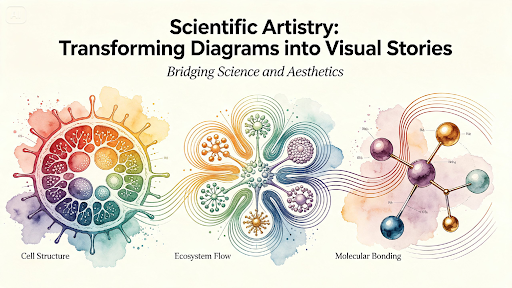
Turn Scientific Diagrams into Visually Engaging Artwork
A textbook diagram can be perfectly accurate and still completely fail to hold anyone’s attention. Dense labels, flat colors, and clinical line art communicate information, but they rarely make anyone actually want to look closer.
An AI image maker offers a way to keep the scientific accuracy intact while giving the visual itself real emotional pull, and Dreamina is especially skilled at rendering complex scientific concepts with genuine artistic polish without sacrificing the clarity that makes a diagram actually useful.
Here’s how to make dense information genuinely beautiful.
Why accurate data still needs an emotional hook
Accuracy alone doesn’t guarantee engagement. A viewer needs a reason to actually study a diagram rather than skim past it, and striking visual choices — color, composition, a touch of drama in the lighting — provide that emotional hook without compromising the underlying facts.
Finding the story hidden inside a data set
Even a purely technical diagram usually contains an implicit narrative — energy flowing through a system, a process unfolding over stages, a structure built from smaller parts. Identifying and emphasizing that narrative visually gives an otherwise static diagram a genuine sense of movement and purpose.
- A process with clear sequential stages
- A structure built from distinct, layered components
- A system showing cause and effect relationships
Choosing which scientific details to simplify and which to keep exact
Not every detail in a scientific diagram carries equal weight for a general audience. Deciding deliberately which elements need precise, technical accuracy and which can be simplified for visual clarity keeps the piece both correct and genuinely readable.
Turn a diagram into artwork in three moves
Dreamina makes producing this blend of accuracy and visual appeal genuinely achievable.
Step 1: Write a text prompt
Go to Dreamina and describe the scientific concept you’re illustrating, including the specific structure or process and the color coding you want applied. Upload a reference diagram if you have existing technical accuracy to preserve.
Example: A visually engaging scientific illustration of a person dressed as an astronomer studying a glowing cross-section of a planet’s layered core, vivid educational color coding, highly detailed infographic style.
Step 2: Adjust parameters and generate
Select Image 5.0 Pro, powered by Seedream 5.0 Pro, for accurate structural detail and consistent color coding across a complex diagram, then set your aspect ratio, canvas size, and resolution — 1K for digital sharing, 2K for print or presentation use. Click the generate icon to render your illustration.
Step 3: Customize and download
Refine the result using Dreamina’s tools: inpaint to adjust specific labels or structural details, expand to add more surrounding context, remove to simplify overly dense areas, and retouch for a final polished finish. Once it’s ready, click Download.
Dreamina: a creative tool with multiple image generation models
Seedream 5.0 Pro
The newest and most capable model in Dreamina’s lineup, Seedream 5.0 Pro handles dense, detail-heavy scientific prompts particularly well thanks to its deep-thinking generation, working through complex structural requirements before rendering rather than losing coherence across a busy composition. This matters enormously for scientific work, where accuracy and clarity both need to survive a genuinely rich visual treatment.
Nano Banana
A faster option for quickly testing a rough layout or color scheme before committing to a fully detailed final illustration.
GPT Image 2
Handles prompts describing multiple specific labeled elements at once closely, useful for diagrams with several distinct parts that all need accurate representation together.
Build visual hierarchy into every scientific layer
A strong scientific illustration should tell viewers where to look first, second, and third. Make the main structure or process the visual focal point, then use smaller labels, arrows, and supporting elements to explain the details.
This layered approach keeps complicated information approachable without removing the depth that makes the subject interesting.
Turn technical concepts into memorable visual scenes
Instead of presenting every concept as an isolated diagram, place it within a meaningful visual setting. A microscopic structure can appear as a detailed close-up, a biological process can unfold like a visual sequence, or an astronomical system can be presented with a sense of scale.
These creative choices make technical information easier to remember while keeping the central concept clear.
Color coding that clarifies instead of confusing
Color should always serve a functional purpose in scientific illustration, not just decoration. Assigning consistent colors to specific categories — one hue for structural elements, another for functional processes — helps viewers parse complex information intuitively rather than relying purely on text labels.
Balancing scientific accuracy with visual style
A stylized illustration doesn’t have to sacrifice accuracy to feel artistic. Keeping proportions, relationships, and key structural details correct while allowing lighting, texture, and composition to carry the visual excitement produces a piece that’s both trustworthy and genuinely engaging.
Making complex processes readable at a glance
For multi-stage processes, a clear visual hierarchy — larger elements for major stages, smaller supporting detail for sub-steps — helps a viewer understand the overall structure quickly, even before reading any individual label closely.
Where this artwork gets used
Scientifically accurate, visually engaging illustration supports work across several fields:
- Textbook and educational curriculum materials
- Science communication content for social media
- Museum and exhibit interpretive displays
- Research presentation and conference materials
Make people want to actually read the diagram
Good science deserves a presentation people actually want to study, not just glance past. With Dreamina and the detail-accurate precision of AI algorithms, dense scientific information can finally look as fascinating as it actually is, and it’s free to start illustrating your next concept today.