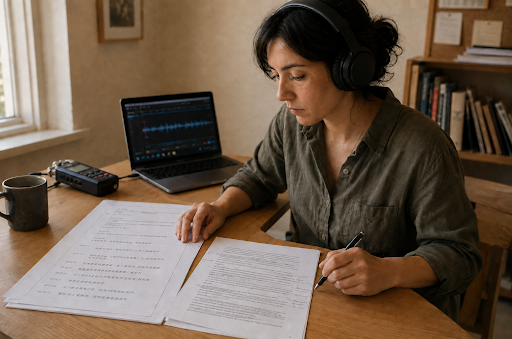
Transcription and translation are often mentioned together because both involve spoken or written language. However, they solve different problems. Choosing the wrong service or device can create unnecessary work and produce an output that does not meet the user’s actual needs.
Transcription creates a written record of speech in the same language. Translation converts meaning from one language into another. Understanding this distinction is important when selecting tools for meetings, interviews, education, international business, or travel.
What Is Transcription?
Transcription converts spoken language into written text without changing the language. An English interview becomes an English transcript, while a Spanish lecture becomes written Spanish.
Common transcription use cases include:
-
Recording interviews
-
Creating meeting minutes
-
Documenting lectures
-
Producing podcast transcripts
-
Converting voice notes into searchable text
-
Creating same-language captions
Transcription is useful when the original conversation needs to be reviewed, searched, quoted, or shared. A journalist may use it to locate statements from an interview, while a project manager may use it to identify decisions and action items from a meeting.
Accuracy depends on audio quality, speaker clarity, accents, background noise, and specialized terminology. Automatic transcripts should be reviewed before quotations, names, numbers, or technical details are used in a final document.
What Is Translation?
Translation converts information from one language into another while attempting to preserve its meaning. It may involve written text, recorded speech, or a live conversation.
Examples include:
-
Translating English speech into Japanese
-
Converting a French document into German
-
Understanding a foreign-language presentation
-
Translating signs or menus with a camera
-
Supporting a multilingual business discussion
Translation requires more than replacing individual words. Sentence structure, context, tone, and cultural expressions can differ significantly between languages.
For this reason, the translated result may need to be rephrased to sound natural. Professional human translation or interpretation remains important for contracts, medical decisions, legal proceedings, and other situations in which an error could have serious consequences.
The Main Difference
The easiest way to understand the difference between transcription and translation is to ask whether the language changes.
If the language remains the same, the process is transcription:
Spoken English → Written English
If the content is converted into another language, the process is translation:
Spoken English → Written or spoken Spanish
Some workflows use both. An international interview may first be transcribed in the speaker’s original language. The verified transcript can then be translated for readers in another country.
Completing these steps separately can make the final result easier to review because the original-language text remains available as a reference.
Which One Is Needed for Meetings?
A meeting involving participants who speak the same language usually needs transcription. The objective is to preserve the discussion and create a searchable record.
Once the transcript is available, the team can extract decisions, responsibilities, deadlines, and unresolved questions. AI tools may also help generate a summary, but important details should still be checked against the original audio.
A multilingual meeting may require translation or interpretation so participants can understand one another during the discussion. If the organization also needs formal minutes, it may use transcription and translation together.
Before the meeting, confirm the required languages, whether live translation is needed, and whether recordings are permitted.
Which One Is Needed for Interviews?
An interviewer normally needs transcription when the interviewer and participant use the same language. The transcript provides material for quotations, research coding, or later analysis.
Translation becomes necessary when the interview is conducted in a language that the final reader does not understand. A strong workflow is to preserve the original recording, create an original-language transcript, verify it, and then translate the approved text.
This approach reduces the risk of losing meaning and gives editors or researchers a clear source to review.
Which One Is Needed for Travel?
Travelers are more likely to need translation than formal transcription. They may need to ask for directions, speak with hotel employees, understand transportation information, or read local signs.
Voice translation helps with spoken conversations, while camera translation can process menus, documents, and signs. Offline translation may also be useful in locations with limited internet access.
A dedicated device such as the iFLYTEK Smart Translator is designed for these scenarios. Its official product information describes face-to-face voice translation, photo translation, and offline translation capabilities, with voice translation covering more than 60 languages.
Users should verify that the required language pair is supported in the intended mode, particularly when they expect to work without an internet connection.
How to Choose the Right Tool
Start by answering four questions:
-
Do you need written text or cross-language understanding?
-
Will everyone use the same language?
-
Is the conversation live or already recorded?
-
What happens if the output contains an error?
Choose transcription when the goal is to create a written version of speech. Choose translation when people need to understand content in another language. Use both when a multilingual recording must become an accurate translated document.
The level of risk should influence the amount of human review. Automated tools are useful for routine meetings, travel, education, and preliminary research. Professional support is appropriate when the content affects contracts, healthcare, legal rights, or safety.
Transcription preserves what was said. Translation helps another audience understand it. Selecting the correct process from the beginning saves time and produces a result that is clearer, easier to verify, and better suited to its intended purpose.