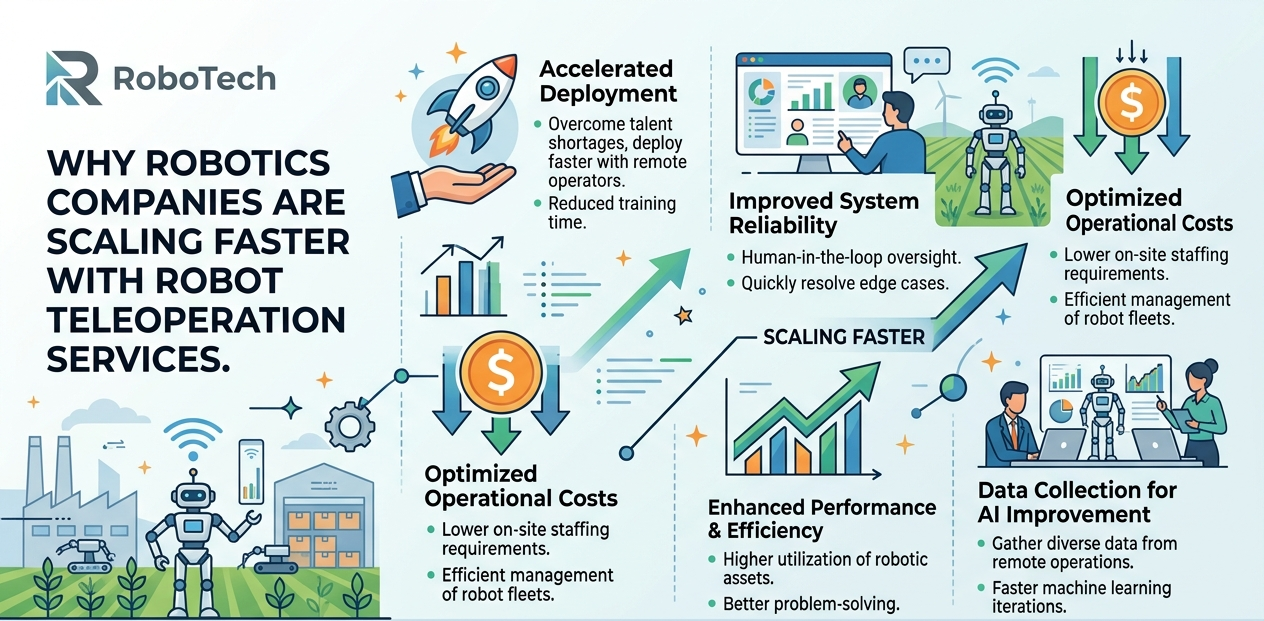
The robotics industry is growing rapidly as businesses adopt automation to improve efficiency and reduce operational costs. From logistics and healthcare to retail and security, robotics companies are expanding their operations at an unprecedented pace. However, scaling robotic systems comes with challenges, especially when dealing with real-world environments.
This is where robot teleoperation services play a crucial role. By combining human expertise with automation, these services enable robotics companies to scale faster while maintaining performance, safety, and reliability.
What Are Robot Teleoperation Services?
Robot teleoperation services involve trained professionals who remotely control or assist robotic systems in real time. Instead of relying solely on autonomous functions, these services allow human operators to step in when needed.
Teleoperation typically includes:
- Remote control of robots
- Real-time monitoring and support
- Handling complex or unpredictable situations
- Optimizing robot performance
This approach creates a balance between automation and human decision-making.
The Challenge of Scaling Autonomous Robotics
Scaling robotic operations is not as simple as adding more machines. As systems grow, so do the complexities involved in managing them.
Common challenges include:
- Handling unpredictable environments
- Managing multiple robots across locations
- Maintaining consistent performance
- Ensuring safety in dynamic conditions
Without proper support, these challenges can slow down growth and increase operational risks.
How Teleoperation Accelerates Scaling
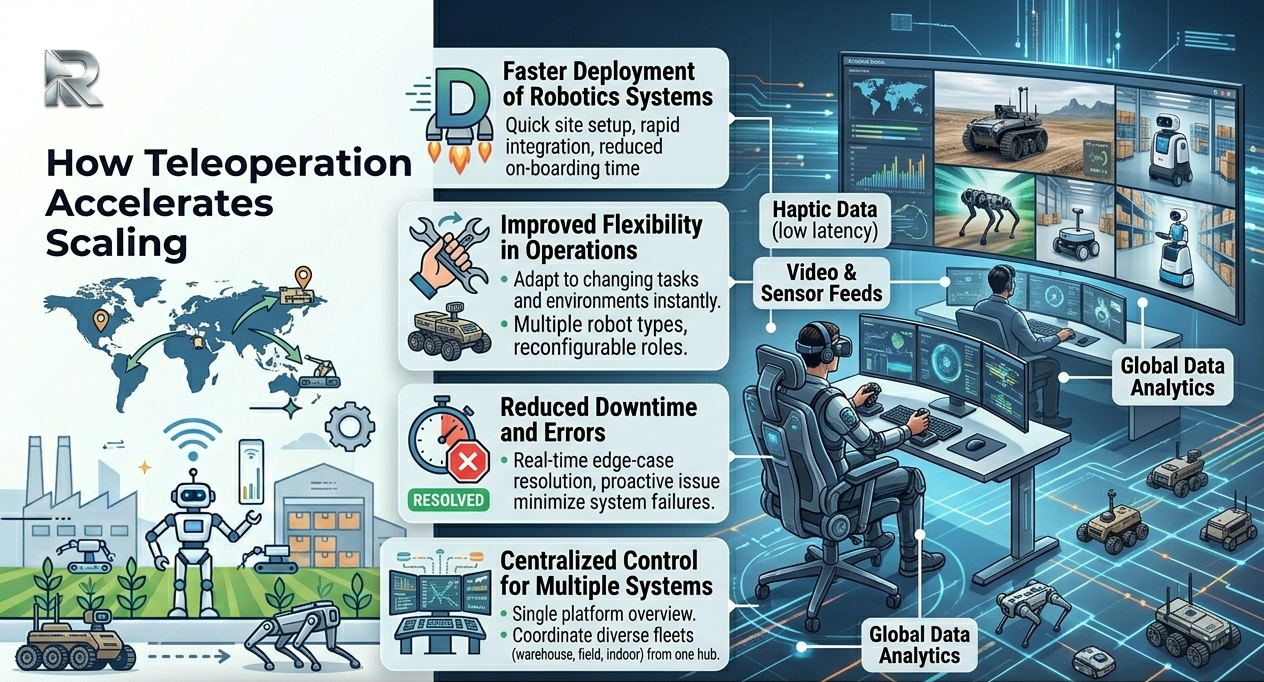
Robot teleoperation services help overcome these challenges by providing real-time human support. This allows companies to expand operations more confidently.
1. Faster Deployment of Robotics Systems
Teleoperation allows companies to deploy robots quickly, even in environments where full automation is not yet reliable. Human operators can guide systems during the early stages of deployment.
2. Improved Flexibility in Operations
Robots supported by teleoperation can adapt to changing conditions. Operators can adjust actions in real time, making systems more versatile.
3. Reduced Downtime and Errors
When issues arise, remote operators can respond immediately. This minimizes disruptions and keeps operations running smoothly.
4. Centralized Control for Multiple Systems
Teleoperation enables companies to manage multiple robots from a central location. This simplifies operations and reduces the need for large on-site teams.
Enhancing Safety and Reliability
Safety is a key factor when scaling robotics. Teleoperation services provide an added layer of protection by ensuring that human oversight is always available.
Benefits include:
- Immediate response to potential risks
- Better handling of unexpected situations
- Improved compliance with safety standards
This makes it easier for companies to scale without compromising safety.
Supporting Cost-Effective Growth
Scaling robotics operations can be expensive, especially when building in-house teams. Teleoperation services provide a cost-effective alternative.
Companies can:
- Reduce the need for on-site staffing
- Lower training and infrastructure costs
- Optimize resource allocation
This allows businesses to expand while keeping expenses under control.
Key Use Cases Across Industries
Robot teleoperation services are used across various industries to support scaling.
- Logistics and Warehousing– managing large fleets of robots
- Healthcare– assisting medical robotics systems
- Retail– supporting customer-facing robots
- Security– guiding patrol robots in real time
- Autonomous Delivery– managing last-mile delivery systems
These use cases show how teleoperation enables efficient growth in different sectors.
The Role of Professional Teleoperation Services
Many robotics companies rely on professional robot teleoperation services to support their operations. These services provide skilled operators who monitor and control systems in real time.
With expert support, businesses can:
- Improve operational efficiency
- Reduce downtime
- Enhance system performance
- Scale operations more effectively
Future of Teleoperation in Robotics
As robotics technology continues to evolve, teleoperation will remain a key driver of growth. Advances in artificial intelligence, connectivity, and user interfaces will further improve remote control capabilities.
Future trends include:
- AI-assisted teleoperation
- Improved real-time communication systems
- Integration with advanced analytics
- Expansion into new industries
Final Thoughts
Robot teleoperation services are helping robotics companies scale faster by bridging the gap between automation and human intelligence. While robots handle repetitive tasks, human operators provide the flexibility needed to manage complex situations.
By integrating teleoperation into their operations, companies can expand efficiently, reduce risks, and maintain high performance. As the demand for automation grows, teleoperation will continue to play a vital role in enabling scalable and reliable robotics systems.