Introduction
In today’s accelerated product development cycles, engineers face a critical challenge: minor errors in design files can lead to prototype failure, budget overruns, and project delays. Studies indicate that up to 30% of rapid prototype projects require rework due to design file issues. These errors often stem from oversights during the design phase, such as ambiguous dimensioning,unreasonable tolerances, or geometric conflicts. While traditional manufacturing has little tolerance for such mistakes, the demands of rapid prototyping are even more stringent.
This article explores how to apply the concept of textual proofreading to establish a systematic design review process for metal rapid prototyping and explains how partnering with a certified manufacturer can mitigate these risks. Let’s delve into the critical impact of design accuracy on prototyping success.
Why Do Minor Errors in Design Files Cause Prototype Costs to Soar by 300%?
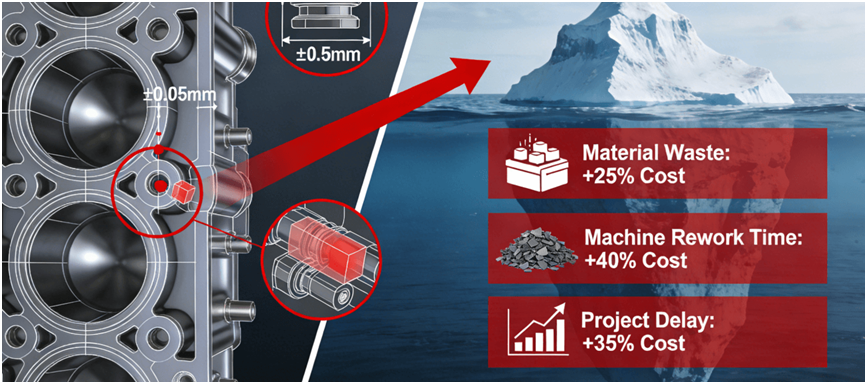
In metal rapid prototyping, a seemingly insignificant error on a drawing can be catastrophically amplified in the real world. The stark contrast with textual errors is clear: a typo might require a backspace keystroke, while a flawed design feature translates to scrapped expensive metal stock, halted CNC machinery, and disrupted project timelines.
The surge in rapid prototyping cost is driven by the “amplification effect” of errors. Correcting a mistake during the design phase costs almost nothing, but discovering it post-manufacture incurs the full sum of material, machine time, labor, and delay costs. Research by the American Society of Mechanical Engineers (ASME) on design standards underscores that clear, unambiguous technical documentation is a prerequisite for manufacturing success.
Consider a missed thread depth call out error leading to an entire batch of costly aerospace aluminum components being scrapped due to assembly failure. The cost structure is compound: design modification requires re-review and release; material waste directly consumes high-value metal blanks; and time delay may cause missed critical testing windows, representing the highest indirect cost. Therefore, treating design accuracy as the primary lever for controllable cost is central to managing the total expense of metal rapid prototyping.
What Are the Common Spelling Errors in Metal Rapid Prototyping?
H3: Design Specification Definition Errors
Precise and unambiguous specifications are the blueprint for manufacturing. Common pitfalls in this category render a prototype unreliable for validation.
l Dimensional and Tolerance Errors:
Unnecessarily pursuing limit precision (Over Tolerancing) drastically increases machining difficulty and cost without benefit. Conversely, Under-Tolerancing or Omissions yields parts that cannot assemble or function, voiding the prototype’s purpose.
l Ambiguous Material and Process Specifications:
Specifying generic “stainless steel” versus a precise grade like 304 or 316 leads to uncertain outcomes, as alloys differ vastly in properties, machinability, and rapid prototyping cost. Similarly, omitting critical surface finish, heat treatment, or coating requirements can cause prototypes to fail performance tests.
Technical File and Data Integrity Errors
Flaws in the design file itself or its data structure directly disrupt the rapid prototyping process, causing failures before machining even begins.This category includes Geometric Interference (undetected part collisions requiring rework), Incomplete Drawings (missing views or notes forcing machinist assumptions), and File Format/Data Issues. Using non-standard file formats or supplying models with “dirty” geometry (gaps, bad surfaces) causes translation errors or CAM software failures in the CNC rapid prototyping workflow, halting production.
How to Proofread Your CAD Design File Like a Text?
The best strategy to avoid design errors is to institute a systematic review process, akin to textual proofreading. This not only enhances the reliability of the rapid prototyping process but applies the writing accuracy tool philosophy to engineering design.
First, utilize CAD software’s built-in “grammar check” tools: run interference analysis, tolerance stack-up analysis, and draft analysis to automatically identify geometric and structural issues. Second, create a “Design Review Checklist” mandating verification of 10+ key items: Are dimensions fully defined? Are tolerances current and per ASME Y14.5? Are material specs explicit? Are critical features annotated?
Team collaboration is also vital. Just as a manuscript benefits from a second proofreader, implementing a “four-eyes principle” with cross-review by another engineer often catches issues the designer misses due to familiarity. Standards from the International Organization for Standardization (ISO) for technical documentation (e.g., ISO 8015) provide a framework for this standardization. Ultimately, combining the efficiency of automated checking tools with the experiential judgment of human engineers builds the most robust design quality defense.
How Does CNC Rapid Prototyping Transform Design Accuracy into a Cost Advantage?
CNC rapid prototyping is the preferred choice for functional metal prototypes due to its high precision, broad material compatibility, and fast turnaround. However, its “subtractive” nature means design accuracy directly dictates material utilization and machining efficiency, translating into significant cost advantages.
Precision and First-Pass Yield
CNC machining achieves exceptional dimensional accuracy. A precise design file means the machine can follow the program exactly, producing on test parts in one go without post-machining adjustments, saving considerable machine time and labor—critical for rapid prototyping metal parts.
Material Utilization and Design Optimization
An accurate 3D model allows for precise toolpath simulation and nesting, maximizing the number of parts yielded from a single raw material block, minimizing waste. Furthermore, clear design intent enables manufacturers to provide Design for Manufacturability (DFM) suggestions, such as optimizing fillet radii or standardizing hole sizes, to further enhance machining efficiency and tool life. This optimization is a cornerstone of controlling overall project cost.
l The Compounding Effect in Rapid Iteration
In fast-paced iterative development, the accuracy of the first prototype sets a reliable benchmark for subsequent design improvements. If the foundational prototype is dimensionally precise and functionally sound, later design changes and testing can focus on performance optimization rather than correcting basic errors. This compounding “interest” on design accuracy can drastically shorten the overall development cycle. To explore a professional rapid CNC prototyping service solution that prioritizes this accuracy, visit our service page.
l Leveraging Professional DFM Analysis
A key advantage of partnering with an expert manufacturer is their ability to perform in-depth DFM analysis. This process acts as a final, expert proofread, identifying potential issues like impractical deep cavities, inaccessible features, or unsustainable tolerances before manufacturing begins, preventing costly mistakes.
5: What Accuracy Certifications Should You Look for When Choosing a Rapid Prototyping Service?
In demanding sectors like automotive or aerospace rapid prototyping, a manufacturer’s international certifications objectively signify its “systemic accuracy” capability. Adherence to standards like ISO 9001 (quality management), IATF 16949 (automotive), and AS9100D (aerospace) demonstrates a commitment to globally recognized quality frameworks. However, the true substance of an accuracy commitment lies beyond the certificates, embedded in the underlying quality control ecosystem—from rigorous document control and First Article Inspection (FAI) to advanced measurement capabilities and integrated DFM analysis. When evaluating a supplier, it is essential to probe these practical processes. A manufacturer like JS Precision, which holds such certifications, exemplifies this proven, systemized approach to quality and precision.
Conclusion
Design file accuracy is the cornerstone of successful metal rapid prototyping. Through systematic review processes, application of professional tools, and selecting manufacturing partners with rigorous quality certifications, engineers can significantly reduce project risk, control costs, and accelerate time-to-market.Immediately upload your design files for professional manufacturability analysis and an instant quote. Let professional team help identify potential design issues, ensuring your next rapid prototyping project starts on the right track.
Author Biography
This article was written by precision manufacturing experts with over 10 years of hands-on experience in the rapid prototyping field. The author’s company, JS Precision, holds multiple international certifications including ISO 9001, IATF 16949, and AS9100D, specializing in providing high-precision, rapid manufacturing solutions for global clients.
FAQ Section
Q1: What is the most common error in design files?
A: The most common errors include improper dimensional tolerance settings, geometric interference, ambiguous material specifications, and missing surface roughness requirements. These errors can lead to prototypes that fail to assemble or function.
Q2: In rapid prototyping, how much do design errors typically increase cost?
A: Industry data suggests design errors can increase costs by 30% to 300%, depending on the error’s severity and the stage at which it is discovered. The cost of correction is lowest when errors are found early.
Q3: How can I quickly check the accuracy of a CAD file?
A: It is recommended to use the CAD software’s built-in analysis tools for interference checks, tolerance analysis, and simulated assembly. Simultaneously, implementing a standardized design review checklist ensures all critical items are verified.
Q4: What are the special requirements for design files in CNC rapid prototyping?
A: CNC machining requires a complete 3D model, clear tolerance callouts, material specifications, and surface finish requirements. File formats such as STEP or IGES are recommended to ensure compatibility.
Q5: When choosing a rapid prototyping service, what should I look for beyond price?
A: Key focus areas should include the supplier’s quality certifications, technical team experience, equipment precision, range of material options, and design feedback capability. Professional DFM analysis can identify and resolve potential issues in advance.