Every high-converting website has a secret. It is rarely the ad budget, the product price point, or even the quality of the copy. More often than not, the variable separating a website that converts at 1.2% from one converting at 4.8% is design specifically, the quality of professional UI design services behind the interface.
This is not an aesthetic argument. It is a business one. And the data behind it is more concrete than most marketing teams realise.
First Impressions Are a Design Problem
Users form a judgment about your website in approximately 50 milliseconds. Before they have read a single word of copy, before they have seen your pricing, before they understand what your product does, they have already decided whether they trust you. That judgment is based entirely on visual design.
This is where professional UI design services deliver their first measurable return. A poorly structured layout, inconsistent typography, misaligned elements, or an unclear visual hierarchy signals unprofessionalism instantly. Users do not articulate this reasoning. They simply leave. The bounce rate climbs, the ad spend goes to waste, and the cause is misattributed to targeting or copy when the real problem was the interface.
A well-executed UI communicates credibility before a single interaction occurs. That is not a soft benefit. It directly determines whether your traffic converts or evaporates.
Visual Hierarchy Drives Conversion Paths
One of the most underappreciated functions of UI design services is the strategic control of attention. Every page has a job to do. That job requires users to notice specific elements, in a specific order, and take a specific action. Visual hierarchy is the design system that makes this happen.
When hierarchy is weak, users scan randomly, miss key information, and exit without converting. When hierarchy is intentional, the eye moves from headline to proof to call to action in a sequence that feels natural but is entirely engineered. Button size, contrast ratios, whitespace distribution, and color weight are all tools in this process.
Businesses that invest in professional UI work report that their calls to action get seen more, clicked more, and followed through on more often not because the offer changed, but because the design made the path to conversion obvious.
The Relationship Between UI and User Experience Design Services
UI design does not operate in isolation. The best-performing interfaces are built on a foundation of user experience design services that have already answered the structural questions: What does the user need to accomplish? What information do they need at each stage? Where do they typically hesitate or drop off?
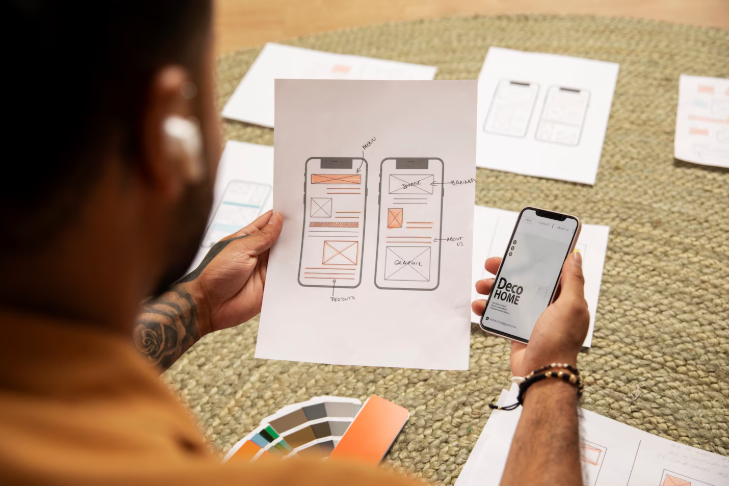
User experience design services provide the blueprint. UI design services bring it to life visually. When these two disciplines work together, the result is an interface that is both logical and visually compelling one that reduces friction at every stage of the conversion journey.
When they operate independently, or when UI is applied to a flawed UX foundation, design effort is wasted. Beautiful interfaces built on poor user journeys still lose users. This is why high-performing agencies treat both as inseparable parts of a single engagement.
Where Usability Testing Services Close the Loop
Even the most experienced UI designers work with assumptions. They hypothesise about what users will notice, what they will click, and where they will encounter confusion. Usability testing services replace those assumptions with observed behavior.
When a UI is tested with real users before launch, the findings are consistently surprising. Elements that designers considered intuitive turn out to confuse users. CTAs that seemed prominent are overlooked. Navigation labels that feel self-explanatory generate repeated wrong clicks. These are not design failures, they are normal outcomes of building for users who think differently than the design team.
Usability testing services catch these issues before they become live conversion losses. A single round of testing that identifies three high-impact friction points and resolves them before launch can lift conversion rates by double digits. The cost of the testing session is typically recovered within weeks of the redesigned page going live.
What Measurable UI Impact Actually Looks Like
The business impact of professional UI design services shows up across several metrics that most companies already track.
Conversion rate is the headline number, but it is supported by others. Time on page increases when design is clear and content is well-structured. Exit rates on key pages fall when the next step is visually obvious. Return visit rates rise when the experience is pleasant enough to bring users back. Cart abandonment drops when the checkout UI removes unnecessary complexity and builds visual trust at the payment stage.
In e-commerce specifically, product page UI has been shown to influence purchase decisions independently of price. Users presented with identical products at identical prices consistently choose the option displayed with stronger visual design. Design is not just packaging. For digital products, it is the product experience itself.
The Compounding Advantage of Good UI
One of the strongest arguments for investing in UI design services is the compounding nature of the return. A well-designed interface does not just convert the next visitor better it converts every visitor better, indefinitely. It makes every ad campaign more efficient. It makes every email sequence more likely to close. It makes every retargeting audience easier to convert.
Businesses that treat UI as a one-time project rather than an ongoing investment eventually fall behind competitors who continue to refine. But businesses that get the foundation right early through professional design, grounded in user experience design services and validated by usability testing services build a compounding advantage that gets harder to close over time.
The secret behind high-converting websites is rarely a single insight or a clever trick. It is the sustained, disciplined application of design thinking to every surface a user touches. That is what professional UI design services deliver, and that is why the businesses using them tend to pull ahead and stay there.
Ending Thoughts
High-converting websites are not accidents. They are the result of deliberate, informed design decisions made by people who understand how users think, what they trust, and where they disengage. Professional UI design services give businesses the structural advantage to make those decisions correctly from the start, rather than reverse-engineering problems after launch. Combined with user experience design services and validated through usability testing services, good UI becomes a permanent performance asset embedded into every campaign, every visitor session, and every revenue outcome. Stop treating design as a cost to minimise. Start treating it as the conversion infrastructure your entire digital strategy runs on.
FAQs
Q1. What are UI design services and what do they include?
UI design services cover the visual and interactive layer of a digital product or website. This typically includes layout design, typography selection, color system development, button and component design, iconography, spacing systems, and the creation of responsive design specifications for development handoff. Some providers also include design system documentation, style guides, and ongoing design support as part of a broader engagement.
Q2. How do UI design services differ from user experience design services?
UI design services focus on what users see and interact with visually the interface itself. User experience design services address the broader journey: user research, information architecture, wireframing, flow mapping, and ensuring the product solves the right problem in the right sequence. In practice, strong digital products require both. UI without UX can look polished but feel confusing. UX without UI can be logically sound but visually unconvincing.
Q3. How quickly can UI changes improve website conversion rates?
Depending on the scope of changes and the volume of traffic, measurable conversion improvements from UI redesigns can surface within two to four weeks of going live. High-traffic sites with robust A/B testing infrastructure can identify statistically significant lifts even faster. Smaller sites may need 60 to 90 days to accumulate enough data for confident conclusions, but directional improvements in bounce rate and session duration are typically visible sooner.
Q4. Do I need usability testing services before or after a UI redesign?
Ideally, both. Usability testing services conducted before a redesign reveal the specific friction points and confusion patterns that the new UI needs to address. Testing conducted after launch validates whether the redesign resolved those issues and catches any new problems introduced during the process. Running both rounds is the most reliable way to ensure the UI investment delivers the expected business results rather than simply looking different.
Q5. How do I choose the right UI design services provider for my business?
Look for providers who ask about your conversion goals and existing metrics before discussing design preferences. A strong UI design services partner will want to understand your user research, your current funnel performance, and your development constraints before opening a design tool. Ask to see case studies that include measurable business outcomes, not just visual portfolios. If a provider can only show you how things looked before and after, rather than how performance changed, that is a meaningful gap.