You’re tired of driving to the gym, waiting for a squat rack, and paying $80 a month for the privilege. Sound familiar? Thousands of Australians are making the switch to home gyms — and not just the ones with big garages and bigger budgets. People in apartments, townhouses, and small suburban homes are building setups that genuinely work, for a fraction of what they’d spend on a gym membership over a few years.
The good news is you don’t need to spend $10,000 or have a dedicated room to make it happen. You just need a plan.
This guide walks you through exactly how to do it — from figuring out your space to choosing the right gear at every budget level.
Why More Australians Are Ditching the Gym
The average gym membership in Australia costs between $40 and $100 per month. Over three years, that’s anywhere from $1,440 to $3,600 — and that’s before you factor in the petrol, the parking, and the time spent commuting back and forth.
A home gym, on the other hand, is a one-time investment. Once the equipment is paid off, every workout is free.
Beyond the cost, there’s the convenience factor. No waiting for machines. No awkward locker rooms. No driving in the rain at 6am. You roll out of bed, walk into the next room, and get it done. That kind of friction-free access makes a real difference to how consistently you actually train.
Start Here — Figure Out Your Space First
The biggest mistake people make is buying equipment before they know where it’s going. Measure first, shop second. Every time.
Common Space Options for Aussie Homes
You don’t need a full basement or a double garage. Here are the spaces that work:
Garage: The most popular option for a reason. Concrete floors handle the weight, there’s usually decent ventilation, and noise isn’t a problem. Single-car garages (roughly 15–18 square metres) are enough for a solid setup.
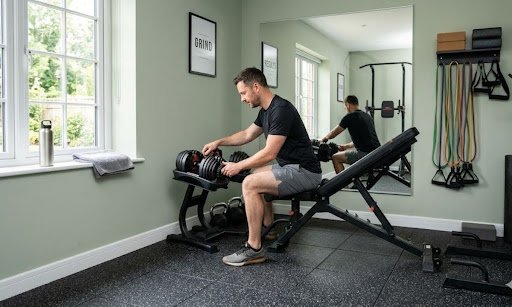
Spare bedroom: Great for lighter dumbbell-based training or resistance work. Carpet floors will need rubber mats underneath any weights.
Living room corner: Totally workable for a starter setup — a mat, some bands, and a pair of adjustable dumbbells don’t take up much space at all.
Covered patio: Increasingly popular, especially in Queensland and parts of NSW where the climate cooperates most of the year.
What to Measure Before You Buy Anything
Standard Australian garage ceilings sit around 2.4 metres. Most full-size power racks are 2.2–2.3 metres tall. If you don’t measure first, you’ll find out the hard way.
Check these before ordering anything:
- Ceiling height — you need at least 2.2m clearance for a rack, more if you plan to press overhead
- Floor area length and width — know your footprint before comparing machines
- Floor type — concrete, timber subfloor, and carpet all need different flooring solutions
- Ventilation — training in a stuffy, unventilated space gets old fast, especially in summer
Build by Budget — Three Tiers That Actually Work
Under $500 — The Starter Setup
This tier is perfect for beginners, people with limited space, or anyone who wants to test the waters before committing to bigger purchases. You can build a genuinely effective training routine with just a handful of items.
What to get:
- Resistance bands (a set with multiple resistance levels)
- Adjustable dumbbells or a basic fixed set (5kg–20kg)
- A quality non-slip exercise mat
- Jump rope
With this setup you can cover full-body strength work, cardio, core training, and flexibility — all from a corner of your living room. Don’t underestimate it. Bodyweight movements like squats, push-ups, lunges, and planks build real strength and require zero equipment.
$500–$1,500 — The Functional Setup
This is where things get interesting. At this budget level you can put together a setup that handles the majority of strength training goals without taking up a lot of floor space.
What to get:
- Hex dumbbell set (5kg to 30kg)
- Adjustable FID bench (flat, incline, decline)
- Barbell and a starter set of bumper plates
- Rubber gym flooring (at least 3m x 3m)
The FID bench alone transforms what you can do with a basic dumbbell set. Chest press, incline rows, shoulder press, tricep work — one piece of equipment, dozens of exercises. If you’re looking at quality home gym equipment Australia options at this price point, prioritise the bench and dumbbells before anything else.
$1,500–$3,000+ — The Full Setup
At this level you’re building something close to a real gym. This setup suits experienced lifters or anyone serious about long-term strength training.
What to get:
- Power rack or squat rack (with pull-up bar)
- Olympic barbell and full plate set or bumper plates
- FID bench
- Cable machine or functional trainer
- Compact cardio option (rowing machine, air bike, or folding treadmill)
A squat rack isn’t just for squats. You’ll use it for barbell presses, overhead press, deadlifts, and pull-ups. It’s the anchor of any serious home gym. If space is tight, a half rack or folding rack can work almost as well and saves significant floor space.
The Equipment You Should Always Prioritise
Regardless of your budget, the principle is the same: buy multi-use equipment over single-purpose machines.
A chest press machine does one thing. A pair of dumbbells does hundreds. A cable machine or functional trainer can replace five separate machines. The more versatile the piece, the more value you get out of every dollar.
Adjustable dumbbells vs a fixed set: Adjustable dumbbells save space and money if you’re starting out. A fixed hex set is more durable and convenient if budget allows — but takes up more room.
The FID bench: Flat, incline, and decline positions in one piece of equipment. It’s the single most versatile item in any home gym and should be near the top of your list no matter what tier you’re building at.
Resistance bands: Underrated by most people. They’re cheap, take up almost no space, work every muscle group, and are genuinely useful for both beginners and experienced lifters doing accessory work or warm-ups.
Don’t Skip the Basics — Flooring and Setup
Rubber gym flooring is one of those things people skip to save money and always regret. It protects your subfloor, absorbs impact, reduces noise for anyone below or next door, and is easier on your joints than bare concrete. For most home setups, 6–8mm thickness is enough. Go 10mm or thicker if you plan to drop weights.
For lighting, use natural light where you can and add bright LEDs if needed. A well-lit space feels more energising and makes it easier to check your form. A Bluetooth speaker helps too — the difference it makes to a training session is surprisingly real.
Keep storage in mind from the start. Wall-mounted hooks for bands, a basic dumbbell rack, and tidy plate storage make a home gym feel like a proper training space rather than a cluttered corner. A tidy gym is one you’ll actually use.
Tips to Make It Work Long-Term
Start small and add over time. You don’t need to buy everything at once. Start with the essentials for your goals, use them consistently, then add a piece every few months as your needs and budget grow.
Don’t overlook bodyweight training. Push-ups, pull-ups, squats, lunges, and planks are genuinely effective for building strength and endurance. They’re free, require almost no space, and scale to any fitness level.
Schedule your sessions like appointments. The gym down the road has opening hours that force you to show up at a certain time. At home, you set your own schedule — which means you also have to hold yourself to it. Put it in your calendar and treat it like a non-negotiable.
Buy quality once rather than cheap twice. Anything that goes under heavy load needs to be built well. Cheap barbells bend. Cheap benches wobble. Spending a bit more on key pieces upfront saves money in the long run and keeps training safe.
Your Home Gym Doesn’t Need to Be Perfect
It just needs to exist. A $200 setup in a spare room beats a $5,000 plan that never gets off the ground. Start with what you can afford, use what you have, and build from there.
The best home gym is the one you actually train in — whatever that looks like for your space, your goals, and your budget.